
HEKA introduces its first fully computer controlled Oocyte Clamp Amplifier system iTEV 90. This two electrode voltage and current clamp amplifier system features automated clamp parameter adjustment, automated hardware transient compensation, slim size headstages and much more...
Furthermore, the iTEV 90 offers the option for an additional current electrode.
All EPC 10 USB patch clamp amplifiers are now equipped with our new "red star" headstage with improved noise specifications. The new EPC 10 USB headstage labelled with a "red star" yields even lower noise values. Especially the most relevant bandwidth between 1 and 10 kHz could be improved.
Typical Noise RMS values are:
Red Star Headstage
EPC 10 / EPC 9 Headstage
31 fA (1 kHz)
35 fA (1 kHz)
72 fA (3 kHz)
90 fA (3 kHz)
120 fA (5 kHz)
150 fA (5 kHz)
This new "red star" headstage is also available separately as replacement of older headstages of EPC 10 and EPC 10 USB patch clamp amplifiers.
Optionally, special headstages for patch amperometry applications and for 3-electrode configurations are available on request.
HEKA is proud to introduce a manually controllable patch clamp amplifier with analog telegraphing outputs for Gain, Filter Bandwidth, Amplifier Mode and C-Slow. The EPC 800 USB allows third-party acquisition software (e.g. IGOR, Labview, pCLAMP) to read the status of these amplifier settings while recording data.
The EPC 800 USB features automatic compensation routines for Vp-Offset, C-fast and C-slow, includes the low noise "red star" headstage and offers the fast true current clamp circuitry for accurate recording of fast neuronal action potentials.
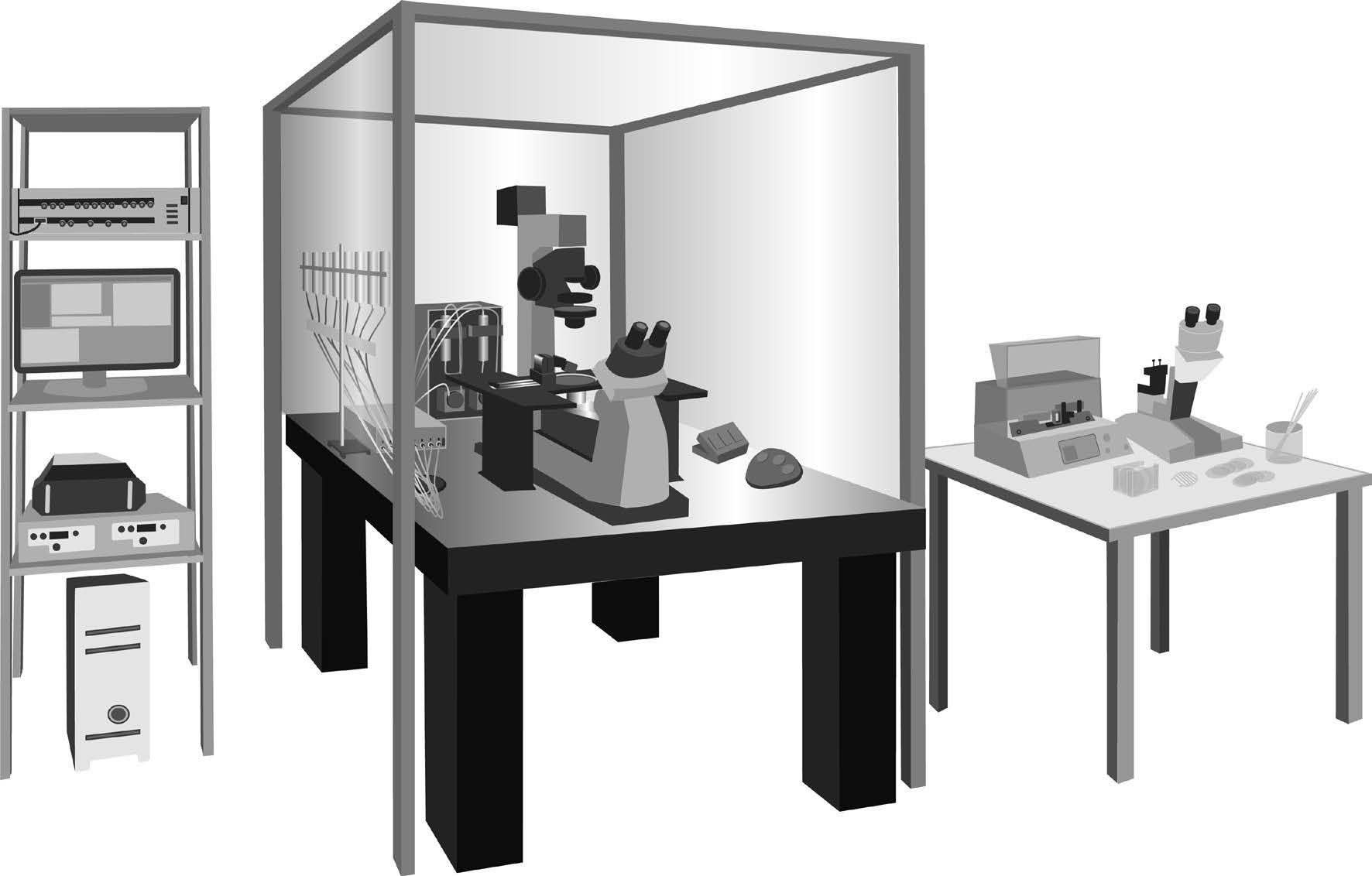
The complete bilayer setup in a bench-top-format, highly automated and equipped with ccd-camera and objective, auto-perfusion, and all electrical compounds for membrane electrophysiology research.
Ionovation Compact opens up a new dimension; the study of membrane channels and transporters from both animal and plant cells and their organelles. No more limitation to suitable cell lines. The response of channel forming proteins to any effector can be investigated, making the Ionovation Compact a powerful tool in pharmacological research, drug discovery, and in academia.
Offering a new add-on approach to standard inverted microscopes, the Ionovation Bilayer Explorer is easy to use, allowing researchers to combine high resolution microscopy and single molecule spectroscopy with state-of- the-art electrophysiology.
Key Features
Easy to use solution for high content electrophysiology combined with state-of-the art microscopy.
Compact add-on design fits onto any inverted microscope.
Intuitive user interface and short learning curve enable fast productivity.
Remote experiment control provides the ultimate in system flexibility.
The PIP 6 has taken all of the exceptional features of its predecessor, the PIP 5, while providing additional improvements to further increase the reliability and reproducibility in the fabrication of micropipettes for nearly any use.
The working distance could be increased for capillaries up to 150 mm in length and the adjustable pipette stop allows fabrication of multiple pulled pipettes to exactly the same lengths.
Photo-activation of excitable cells has proved to be a powerful tool to study connectivity patterns in neuronal slice tissue. In a conventional mapping experiment an intracellular recording from a single cell in the slice is established. The light beam is consecutively focused onto different locations within the surrounding tissue, eliciting spikes in the local cells.
These spikes can be detected as postsynaptic events in the intracellular recording if a functional connection is present within the tissue.
The HEKA ElProScan is an Electrochemical Probe Scanner for various investigations of electrochemical active surfaces. It belongs to the family of the scanning microscopes like AFM, STM or SECM.
The ElProScan can be used as a normal SECM but it is much more than that. The chief difference is the application of any electrochemical method (free programmable pulse protocol) at the tip and not only the recording of tip currents. During the protocol, an independent method can be applied to the sample and run simultaneously with the method applied to the tip. ElProScan, therefore can also be used for active electrochemical surface modification.
The EC_Tools are user friendly masks which help to use a certain electrochemical method or application.
The masks contain only the parameters of interest, the most potentiostat settings are done automatically in respect to the timing and potential resolution of the corresponding experiment. Each mask contains explanations of the stimulation sequences or explains the entire method using graphics or cartoons.
EC_Tools help to get quickly the results of the corresponding electrochemical method and the results of analysis. The selfexplaining user interface requires only a minimum of documentation and guides with comments and diagrams through the method. EC_Tools can be used for standard measurements in industry or for teaching purpose at universities.
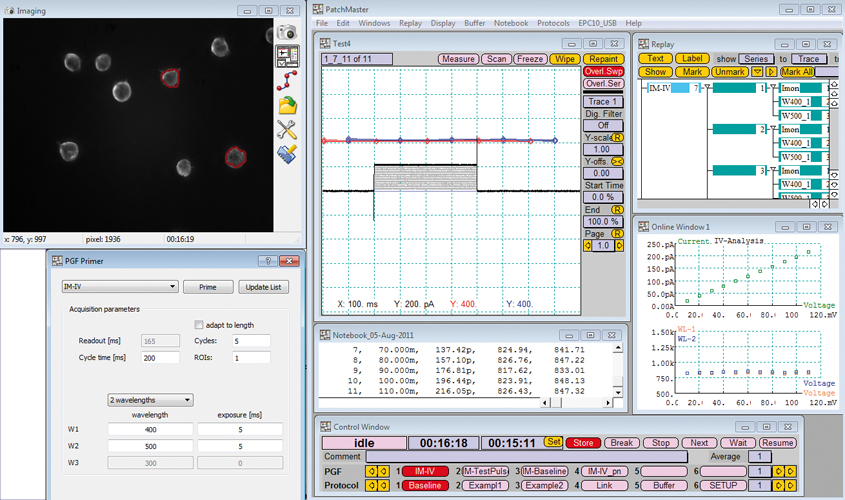
In our ongoing efforts to provide excellent customer support, HEKA is creating PatchMaster and FitMaster tutorials in video-format.
Users can now view step-by-step some of the various approaches used in software configuration, acquisition and analysis for everyday applications.
These tutorials should prove to be a very valuable resource for HEKA software users at all levels. HEKA will consistently add to the tutorial database and we welcome user suggestions.